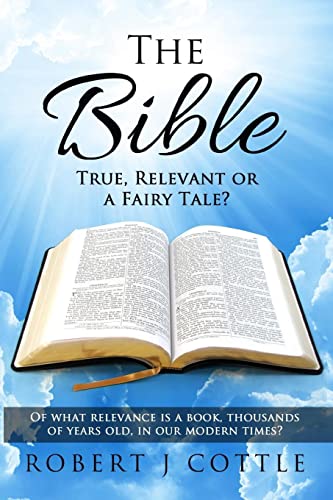
Easy-Reading Synopsis: The Bible: True, Relevant or a Fairy Tale?
Why Scripture still speaks with authority. This ~19-page synopsis stays close to Robert J. Cottle’s own wording—condensed chapter by chapter for clear, unhurried reading.
This is a faithful overview, not a substitute for the full book. Scripture references and arguments follow the manuscript. When you are ready for the complete treatment, get the book on Amazon.
Contents
- Introduction
- Chapter 1: Truth
- Chapter 2: Fact or Fiction
- Chapter 3: Fairy Tales
- Chapter 4: Evidence
- Chapter 5: Prophecy
- Chapter 6: History in the Bible
- Chapter 7: Writing of the Bible
- Chapter 8: Conflicts within the Bible
- Chapter 9: History of the Bible
- Chapter 10: Knowledge
- Chapter 11: What is the Real Story?
- Chapter 12: Who is the God of the Bible?
- Chapter 13: Relevance Today
- Chapter 14: How to Read It
Introduction
The word 'Bible' comes from the Greek and Latin words which mean 'books' and 'the book'. The Bible is a collection of books as well as a single book. Thousands of other books have been written about the Bible over the years. This book however is not written about the Bible but what is it, about the Bible. Very few, in any country around the world, would deny having heard of the Bible. Many millions would claim to have read it or at least read a chapter or two, some perhaps when passing time while enduring a seemingly uninteresting sermon.
Others have made it their life’s work to study every word in it and to delve into the depth of the meaning of each verse. In contrast there are some who have made it their sole ambition to discredit the Bible.
But in spite this lack of serious readership, knowledge and belief the Bible still enjoys the greatest popularity of any book ever produced in human language in terms of ownership at least. I have been concerned for some time that many Christians didn’t really read or believe the Bible but it wasn’t until I began to research for this book that I began to comprehend the magnitude.
Finally, I believe that God has a sense of humour so I have incorporated well-meaning but ambiguous quotes from various church signs around the world at the start of each chapter.
Chapter 1: Truth
“What is truth”? That's the question Pontus Pilate asked Jesus the same day he ordered his crucifixion. You can almost hear his words breaking off to ponderous thought. Pontus Pilate perhaps for the first time in his life paused to consider what truth actually was. This is a man who at the time was Prefect of the Roman province of Judaea serving under Emperor Tiberius and as such was granted the power of supreme judge. He had the sole authority to determine a criminal’s fate and had likely passed numerous judgements involving lengthy prison sentences or the Roman favourite, crucifixion.
Yet amazingly here he was trying to figure out what truth actually is. Sounds ridiculous doesn’t it? Fortunately today with much better education we all fully understand what “truth” is, - don’t we? The Merriam-Webster's Learner's Dictionary gives the simple definition of truth as: 1 The real facts about something: the things that are true. The quality or state of being true. A statement or idea that is true or accepted as true. The standout word in those definitions is the word “true” – the real facts. Things are either true or false, it is a binary term.
There is no such thing as half-truths or white lies; despite the fact they’re common in our vocabulary. The meaning of “I am ok,” most will understand, often has little actual truth in it. Merely saying something doesn't make it true.
It’s the expression of the lie the serpent told the woman in Genesis 3:4 to convince her to eat the forbidden fruit in the Garden of Eden. “Your eyes will be opened, and you will be like God, knowing good and evil.” (Emphasis added). Man thinks he is “like” God believing his thinking and reasoning creates truth. What utter audacity – man is a created being, and that is truth. To be very clear, truth is not fluid, nor is it malleable. It is not created; it exists regardless of any human understanding.
Adding an “s” to truth (truths) does not change the underlying meaning, it does not mean there are many different interpretations, as truth is absolute. Simply because I may not be able to personally verify a truth does not negate the fact that it may be true. God exists even if I haven’t verified it personally. But of course the earth is flat?
Two dangerous negating factors of truth are perceived truth and cotton wool padded truth. “Why let the facts stand in the way of a good story” – anonymous.
Chapter 2: Fact or Fiction
The darkness was so thick it could be felt and deathly silence was the only atmosphere. Without any precursor suddenly a gigantic thunderous explosion burst out from the centre of this nothingness, simultaneously blasting white hot molten rock and superheated gases in every direction at the speed of light. Darkness was no more, neither was the extreme emptiness. Masses of liquefied rock and gas spewed from the epicentre like continuously erupting popcorn. Smaller globules of molten rock crashed into larger ones as they screamed outwards into the deep darkness of outer space.
For years, centuries and many millennia these molten rocks journeyed onwards to unknown destinations frequently colliding and merging with larger cooling masses of rock and huge gas clouds. It took a few billion years but eventually some form of organised chaos prevailed. No longer were these rocks hurtling in every which direction. In one particular corner of space several, now much cooler gigantic rocks and enormous gas balls had organised themselves into a group dominated by a colossal gaseous fiery mass which became known as Helios. A gravitation effect held the spherical masses in a trance like orbit around Helios even though there were millions of miles between them.
One particular rock sphere had fortuitously gained an orbit about 93 million miles from Helios. This resulted in near optimum temperature zones allowing liquid water to flow freely and water now covered almost its entire surface. This utopia rock eventually became known as Gaea.
It is widely accepted that the movement of the earth’s tectonic plates did create the shape and locations the land masses we now have, except most hold that this could only have occurred over a very long time period. John Baumgartner demonstrates however that these plates moved rapidly, in relative terms, causing catastrophic upheaval. The Bible completely supports this fact, when it states in Genesis 7:11 “the fountains of the great deep were broken up”.
I have used stories in this book to better explain things and likewise a parable is just a story used to illustrate a point.
Chapter 3: Fairy Tales
Start a paragraph with “Once upon a time” and generally our minds will flip to fairy tale mode. Since the Bible is the inspired word of God it may be surprising to some that these actual words are found in the Bible. Judges 9:8 reads: “Once upon a time the trees decided to choose a king. First they said to the olive tree, 'Be our king!'….” (NLT). Other versions use slightly different wording, the New King James reads “The trees once went forth to anoint a king over them. And they said to the olive tree, ‘Reign over us.” The basic meaning is the same; it’s the start of a fairy tale.
Yes, the Bible does contain fairy tales with this one in Judges being the obvious example. This story in Judges was recited by a man named Jotham the youngest son of Gideon (Gideon was also called Jerubbaal), one of the great Judges of Israel before it became a Kingdom. Gideon had a total of seventy sons – one would hope through multiple wives. He also had a mistress (concubine) who gave birth to his son Abimelech. When his father died, Abimelech went to Shechem, the city of his mother, and sweet-talked his relatives into appointing him their ruler.
Man tends to consider God strictly in human terms, which is incredibly limiting. The whole of the Bible is about God, but even so it realistically only covers the basics. God is wonderful, mighty, absolute sovereign, immortal, over all things, omnipresent (present all the time or everywhere), omnipotent (possessing complete, unlimited, or universal power and authority). 1 Timothy 6:15-16 “which He will manifest in His own time, He who is the blessed and only Potentate, the King of kings and Lord of lords, who alone has immortality, dwelling in unapproachable light, whom no man has seen or can see, to whom be honor and everlasting power.
Amen.” That’s just a few of the basic characteristics of the one and only God. Regardless of man’s opinion He definitely is not a fantasy figure in a fairy tale. He’s absolutely real and has complete, unlimited, or universal power and authority.
Chapter 4: Evidence
The word "Bible" comes from bíblia in Latin and bíblos in Greek. The term means book, or books. The word probably originated from the ancient Egyptian port of Byblos (in modern-day Lebanon), where papyrus was used for making books and scrolls then exported to Greece. Genesis, the first book of the Bible was written about 1400 BC and the last book of Revelation about 96 AD. So, essentially it’s a very old book! But just because it’s ancient, does that make it untrustworthy? What other aged documents are of a similar age?
The earliest known written non-Biblical literature, the classical Sumerian, dates from about 2600 BC. The earliest literary author known by name is Enheduanna, dated to around 2400 BC. Some literary texts, such as the Book of the Dead, ancient Egyptian funerary texts, were recorded in the Papyrus of Ani around 1240 BC, but other versions of the book date from about 1800 BC. In fact today there are 33 known writings which are believed to predate the 1400 BC writing date of Genesis and a couple that, we’re told, predate Noah’s flood of about 2300 BC.
What’s interesting is that very little controversy surrounds any of these writings. Generally they’re accepted as what probably did occur at that period. Clearly some writings are mythical or poetic but most in their own way do provide a tiny window to life in that era.
The tablets refer to all five "cities of the plain" mentioned in Genesis 14, previously assumed to have been mere legends. Egyptian words in the Pentateuch (first five Bible books). Accurate Egyptian names: Potiphar (Gen.39), Zaphenath-Paneah (Joseph's Egyptian name, Gen. 41:45), Asenath (Gen.41:45), On (Gen. 41:45), Rameses (Gen. 47:11), Oithom (Exodus 1:11). Finds in Egypt are consistent with the time, place, and other details of Biblical accounts of the Israelites in Egypt. These include housing and tombs that most likely belonged to the Israelites, as well as a villa and tomb that is believed to have been built for Joseph.
Confounding earlier sceptics, but confirming the Bible, an important discovery was made in Egypt in 1896. A tablet — the Merneptah Stela — was found that mentions Israel. (Merneptah was the Pharaoh that ruled Egypt in 1212-1202 B.C.) The context of the stela indicates that Israel was a significant entity in the late 13th century B.C.
Only a writer inspired by a supernatural God could predict precisely an event many years in the future.
Chapter 5: Prophecy
Time – we measure time, keep time, meet and greet in time and our daily lives are completely wrapped around the onward lunge of time. We perceive time as past present and future. Mankind in his natural state is locked in time with no means of escape. How many occasions have you expressed; if only I had a little more time? From a kid being told to go to bed at night, to relationships, to learning, to playing, family, friends, everything eventually comes to an end. The well know verses of Ecclesiastes 3:1-8 says it all.
The flow of time is directed by God who appoints particular “times” within His unfolding purposes. God ordered the children of Israel to hold His feasts at their appointed time. Leviticus 23:4 “These are the feasts of the LORD, holy convocations, which you shall proclaim in their appointed times.” [Emphasis added]. God has divided time into seasons Deuteronomy 11:14 “then I will give you the rain for your land in its season, the early rain and the latter rain, that you may gather in your grain, your new wine, and your oil.” [Emphasis added].
God is fully in control of time, He is its director and He sees the entire line of time from His throne. It should come as no surprise then when God tells us of something occurring in the near or distant future.
No one comes to the Father, except through me.” This unequivocally assures us of two things: Through Jesus we have life. Jesus is the only way to get this life.
Chapter 6: History in the Bible
God is a meticulous book keeper and He tells us so: Exodus 32:32 “Yet now, if You will, forgive their sin—but if not, I pray, blot me out of Your book which You have written.” [Emphasis added] Daniel 7:10 “A fiery stream issued and came forth from before him. A thousand thousands ministered to Him; Ten thousand times ten thousand stood before Him. The court was seated, and the books were opened.” [Emphasis added] Revelation 20:12 “And I saw the dead, small and great, standing before God, and books were opened.
And another book was opened, which is the Book of Life. And the dead were judged according to their works, by the things which were written in the books.” [Emphasis added] Revelation 13:8 “All who dwell on the earth will worship him, whose names have not been written in the Book of Life of the Lamb slain from the foundation of the world.” [Emphasis added] Revelation 20:15 “And anyone not found written in the book of life, was cast into the lake of fire.” [Emphasis added] He also has a book of our tears.
Psalm 56:8 “You keep track of all my sorrows. You have collected all my tears in your bottle.
You have recorded each one in your book.” [NLT Version] [Emphasis added] Strangely God also keeps track of the hair on our head, Matthew 10:30 “but the very hairs of your head are all numbered.” Jesus mentions the sheer detail of what he keeps account of in Matthew 12:36 “But I say to you that for every idle word that men may speak, they will give account of it in the day of judgment.” [Emphasis added] Might be a rather long account for some! He also has a book of memory relating to what God hears about those that honour him Malachi 3:16 “Then those who feared the LORD spoke one with another; and the LORD heard them; So a book of remembrance was written before Him for those who fear the Lord and who meditate on His name.” It seems God truly is a prolific author and a stickler for detail.
Few would claim to have not heard of the expressions in the above list and most likely have used them in their day to day conversations, regardless of their religious beliefs.
Chapter 7: Writing of the Bible
Genesis, the first book in the Bible, was written by Moses after the exodus of the children of Israel from Egypt which historians calculate took place around 1445 B.C– about 2,550 years after the creation. Today is just over 2,000 years since Jesus lived on this earth. If someone began to write a detailed book about his life in our day how could we believe it was authentic? I for one may have some doubts, given the very long elapsed time since the event. However is it really that absurd?
Could someone write an authentic account of the life and death of Jesus Christ thousands of years after the fact? To consider that question you must first evaluate how it could be done. Could the author interview any eyewitnesses – no! What historic information is available to the writer – well copious volumes, as it happens? There are literally thousands of historic records and old manuscripts available and any prudent scribe would be well advised to begin by making a detailed study of them. Perhaps then it really could be possible in our day to put together a precisely detailed and accurate account of the life and death of Jesus given the quality of material available.
Naturally the work could not claim to be an original but provided adequate research was carried out it certainly would be authentic even though the subject matter was 2,000 years ago. Why?
Firstly let’s spell out one thing. Genesis is included in the Bible. This means it is part of scripture “given by inspiration of God”. 2 Timothy 3:16 “All scripture is given by inspiration of God, and is profitable for doctrine, for reproof, for correction, for instruction in righteousness.” Jesus himself validates Moses and also the creation account in Mark’s gospel. Mark 10:2-9 “The Pharisees came and asked Him, “Is it lawful for a man to divorce his wife?” testing Him. And He answered and said to them, “What did Moses command you?” They said, “Moses permitted a man to write a certificate of divorce, and to dismiss her.” And Jesus answered and said to them, “Because of the hardness of your heart he wrote you this precept.
But from the beginning of the creation, God made them male and female.
Sadly we can’t record precisely what ensued, but it’s sufficient to say that ten years of Brother Phillip’s pent up frustration spewed to the surface and now unfortunately Father John also faces replicating several of his most recent successes.
Chapter 8: Conflicts within the Bible
Maybe this is going to be a very short chapter as I must state right at the outset that “there are no conflicts within the Bible.” “All right, if you say so; but why then do we hear so many people shouting the opposite?” I’ve had several people tell me, “Oh you can’t trust the Bible, it conflicts itself on almost every page”. My first question in reply, “Perhaps you could show me one or two of them?” At which point the mumbled reply is: “Well they hadn’t actually read the Bible themselves, but that’s what they had heard.” Why then all this discrediting of the Bible in this way, where do these apparent conflicts arise from?
Often the problem of apparent conflict arises when a Bible verse is taken out of context. By context I mean the setting of or intended audience for whom it was written. When looking at the Bible as a whole and understanding its teachings there are simply no contradiction which is remarkable for a book of the Bible's age, size and scope. On face value there may appear to be a small number of apparent discrepancies but these are more curiosity than calamity. They do not touch on any major event or article of faith.
Here is an example of a so-called apparent contradiction. When Jesus was crucified Pilate ordered that a sign be posted on the cross above where Jesus hung.
Three of the Gospels record what was written on that sign: Matthew 27:37, "This is Jesus, the king of the Jews." Mark 15:26, "The king of the Jews." John 19:19, "Jesus of Nazareth, the king of the Jews." In each of these the wording is slightly different, hence the apparent contradiction. The remarkable thing, though, is that all three very different writers describe the same event in such detail -- Jesus was crucified. On this they all agree. They even record that a sign was posted on the cross, and the base meaning of the sign is the same in all three accounts – the King of the Jews!
What about the exact wording? In the original Greek of the Gospels, they didn't use a quotation symbol as we do today to indicate a direct quote. The Gospel writers were making an indirect quote, which would account for the subtle differences in the passages.
Always ask the Holy Spirit to reveal His word as you read and I guarantee He will give you fresh understanding every single time.
Chapter 9: History of the Bible
Understanding the how we came to get our Bible is important. Some youngsters may believe that milk only comes from a supermarket. As they grow, they usually discover that farming and cows are also involved. Perhaps many Christians just view the Bible as another bookstore book and have very little appreciation or understanding of how our present English translations of the Bible came to us. The Old Testament was and in fact still is the Bible of the Jewish faith, Judaism. Before and during the time of Jesus it was considered the only scripture.
Jesus frequently quoted from it throughout His ministry time on earth, as in Luke 24:44 “Then He said to them, “These are the words which I spoke to you while I was still with you, that all things must be fulfilled which were written in the Law of Moses and the Prophets and the Psalms concerning Me." Notice Jesus here refers to three parts; the Law of Moses, the Prophets and the Psalms. This three part distinction is important as it not only clarifies exactly what He was referring to, it also defines how it was fashioned.
Let’s take a closer look at these three sectors. The Law of Moses The opening books of the Old Testament date back some 3,450 years and have been held as the word of God from the outset. And God told Moses to write them.
Exodus 34:27 “Then the Lord said to Moses, “Write these words, for according to the tenor of these words I have made a covenant with you and with Israel.” Deuteronomy 31:24-26 “So it was, when Moses had completed writing the words of this law in a book, when they were finished, that Moses commanded the Levites, who bore the ark of the covenant of the Lord, saying: “Take this Book of the Law, and put it beside the ark of the covenant of the Lord your God, that it may be there as a witness against you;” These books of Moses are considered the authoritative text of the Jewish Bible (the Tanakh) and collectively are known as the Torah.
The Torah refers to the "Five Books of Moses" or the Pentateuch, meaning "five scroll-cases" and consists of Genesis, Exodus, Leviticus, Numbers, and Deuteronomy.
For whoever has, to him more will be given; and whoever does not have, even what he seems to have will be taken from him.” How well are you hearing?
Chapter 10: Knowledge
A well-known Pastor was once invited to a debate at the annual conference of the atheist association. “What’s the debate about?” the Pastor asked. “That there is no God, of course,” the convenor replied. “Our leader will speak first for 20 minutes and then you are allotted 10 minutes to reply,” he continued. “Oh 10 minutes is more than enough,” the Pastor responded, “I’ll doubt I even need that long.” The day arrived and the Pastor entered the packed venue overflowing with confirmed atheists certain they were about to witness their legendary orator utterly humiliate this unsuspecting God-promoter and his grossly out-dated beliefs.
The atheist leader stood up and raged on for a full 30 minutes powerfully expressing his philosophies on the non-existence of God from every viewpoint. As he finished he turned to the sole God believer in the room inviting him to come forward and attempt to refute his compelling argument in his allotted 10 minutes. As the Pastor approached he called to the atheist leader asking him if he would mind staying on stage with him for a moment as he needed his help. The leader quickly agreed as, naturally, the Pastor’s only option was to concede defeat.
“He would be gracious in his acceptance,” the leader mused. The Pastor walked over to a whiteboard and drew a large circle on it. He then asked the atheist, “Imagine this circle represents all the knowledge in the universe, absolutely everything it’s possible to know.
It’s what we don’t know that’s usually dangerous to us. We’ve all heard people’s excuses; “I didn’t know that would happen” or “You should have told me.” Knowledge is to be accumulated and never disseminated. We’re told in Proverbs 23:23 “Buy the truth, and do not sell it, Also wisdom and instruction and understanding.” And God is the only one that knows absolutely everything. 1 John 3:20, “For if our heart condemns us, God is greater than our heart, and knows all things.” [Emphasis added]. Ok, so what exactly is knowledge?
Here’s a dictionary definition: 1 Facts, information, and skills acquired through experience or education; the theoretical or practical understanding of a subject. "A thirst for knowledge" Awareness or familiarity gained by experience of a fact or situation. "The programme had been developed without his knowledge" More importantly is what knowledge is not.
Chapter 11: What is the Real Story?
I haven’t personally counted them but apparently there are 770,430 words in the NKJV Bible. With so many words what’s really the underlying statement the Bible makes? Many people shy away from reading the Bible because of what they think is in it – intolerance, bigotry, rules and narrow mindedness. They perceive God to be ever ready to harshly punish our least mistake in order to teach us how to obey Him. Having read the Bible from cover to cover many times I can personally assure you that none of that has the slightest basis in truth.
The Bible reveals the gospel – the good news of a tender loving God and of salvation through our Lord Jesus Christ. It truly is all good news. Throughout this book we have focused a lot of attention on the book of Genesis, in particular the first few chapters. Why is that important? Why is it necessary for a Christian to believe the creation account? So what if it’s taken millions of years to get us to today? Science confirms that man evolved doesn’t it? Why would a loving God destroy all mankind in a global flood?
Man couldn’t possibly live for nearly 1,000 years, especially given the lack of any modern day health care systems. Wow, steady on with all the questions! Perhaps there is a simple answer. Firstly the Bible account is unambiguous.
Perhaps the creation account is metaphoric recorded as it was passed down by word of mouth by early generations. Lots of man-made explanations but none are very persuasive. Paul told Timothy that every scripture is God breathed, 2 Timothy 3:16 “All Scripture is breathed out by God and profitable for teaching, for reproof, for correction, and for training in righteousness,” (ESV) Every scripture includes the book of Genesis. No doubt left there, the book of Genesis – all of it – is the word of God. Some theologians tell us to simply dismiss the debate about creation as it’s not relative anymore.
It was a long time ago and we live in the day of salvation through the blood of Jesus. Here’s why that’s so wrong.
" It’s about the heart, not the law, and Jesus is the only way to obtain that kind of heart.
Chapter 12: Who is the God of the Bible?
Many folks, rightly or wrongly, have built up a certain picture of God in their minds perhaps because of things they’ve heard or some impression gained through something they’ve experienced or read. It’s surprising to learn that these “folks” are not just unbelievers; I’ve met many Christians whose impression of God was far from whom the Bible describes. Why? They have either never read their Bibles or if they have they simply have not believed what they read. Man’s continued belief that he is “like God” is the problem. It’s not that perhaps some have such an elevated opinion of themselves that they believe they’re a god.
No, it’s far more subtle; they bring God down to human terms. If we compare God to others we know, our natural fathers, friends or relatives, then that is enveloping God in human thinking. It immediately brings up trust, belief, confidence and abilities. The first key to this is belief. We have previously mentioned how imperative it is to believe all that’s written in the Bible. Remember the Bible starts with the phrase “In the beginning God.” If we cannot accept He really does exists when we read the Bible we’re never going to take seriously what it says about Him.
Hebrews 11:6 “But without faith it is impossible to please Him, for he who comes to God must believe that He is, and that He is a rewarder of those who diligently seek Him.” All that’s needed is a simple step of faith. “Ok God I really do accept you exist.” In Mark we have the account of Jesus healing a young boy of an evil spirit Mark 9:22-24 “And often he has thrown him both into the fire and into the water to destroy him. But if you can do anything, have compassion on us, and help us.” Jesus said to him, “If you can believe, all things are possible to him who believes.” Immediately the father of the child cried out and said with tears, “Lord I believe.
No one comes to the Father, except through me.” No one comes to the Father except through Jesus Christ. Nobody – period! There is no other way of salvation and eternal life. Good works or religious behaviours towards God will not do it either.
Chapter 13: Relevance Today
“I’m standing on a sea of pure gold, clear as glass, the opulence and grandeur extreme yet by no means overwhelming. The walls of the city, impenetrable, the gates – what splendour! And those names inscribed above them. The foundations adorned with precious stones, each one magnificently differing from the other. The width and height of the majestic metropolis, awe-inspiring. A brilliant radiance of such a vivid white, though not blinding to the eyes, envelops the atmosphere. I looked around enthralled at the vast multitude of people of every imaginable tongue and nation assembled for the feast.
Across the crowd I see King David, there, further over, is Moses chatting with the Apostle Paul. I spot Noah recounting his ark testimony; oh look there’s Luke the physician enjoying an amusing conversation with Stephen the martyr. Over to the side I catch a glimpse of my grandfather looking young and stately and incredibly there’s my cousin standing beside him – he did make it here. The conversations and laughter saturate my ears; the joy and delight provide a spectacular ambience unlike anything I had ever experienced – truly an absolute paradise of contentment.
The blood of Jesus cleanses us from the curse and creates in us a new creation. Yes we can turn back to a life of sin and despise the gift of eternal life, but generally that is a deliberate, wilful act and not a momentary lapse. If a believer in Jesus falls into some sinful act then the Bible tells us that person can be restored. 1 John 2:1 “My little children, these things I write to you, so that you may not sin. And if anyone sins, we have an Advocate with the Father, Jesus Christ the righteous.” Regrettably the pendulum has swung too far the other way to the extent that we now hear some preachers telling us that Hell is really just a merciful death after the final judgement.
Let me assure you the Bible describes Hell very clearly and it is not a merciful place.
Jesus said in, John 14:6 “I am the way, the truth, and the life. No one comes to the Father, except through me.” There absolutely is no other way.
Chapter 14: How to Read It
We’re told in Psalm 119:105 “Your word is a lamp to my feet, and a light to my path.” God’s word allows movement, direction and light. Conversely, therefore, without God’s Word we’re stumbling around in the dark with no idea where we’re going or why. Obviously physically reading the word of God is very important. However it is an enormous book containing about three quarters of a million words – how do I go about reading it? Understanding the Bible can be daunting, especially to someone not able to read well but also for to those with excellent reading skills.
First up, you have to have a reason to study it and that reason should not be just because we’re told to – although if that’s all you have, do it anyway. Psalm 119 is a very long Psalm but it’s filled with copious descriptions for the desire and hunger for God’s Word. Here’s a sample; Psalm 119:9-16 “How can a young man cleanse his way? By taking heed according to Your word. With my whole heart I have sought You; Oh, let me not wander from Your commandments! Your word I have hidden in my heart, That I might not sin against You.
Blessed are You, O Lord! Teach me Your statutes. With my lips I have declared All the judgments of Your mouth. I have rejoiced in the way of Your testimonies, As much as in all riches.
So-called church leaders in the past have used isolated verses of scripture, generally out of context, to justify all sorts of religious piety. God’s word is not for private interpretation. The Apostle Paul makes it clear where our understanding comes from when he was writing in Colossians 1:9 “For this reason we also, since the day we heard it, do not cease to pray for you, and to ask that you may be filled with the knowledge of his will in all wisdom and spiritual understanding; that you may walk worthy of the Lord, fully pleasing Him, being fruitful in every good work and increasing in the knowledge of God.” [Emphasis added].
We do the reading; the Holy Spirit gives the understanding and thereby we grow and bear fruit.
(Non-fiction) Not Many Fathers, why Othniel became a Judge. (A novel, fiction.) Eschatology 101, What the Bible says about the end of time. (Non-fiction)